RUN
Operate effectively and create visibility into the current ecosystem.
Program infrastructure, decision intelligence, and continuous improvement designed to Run, Grow & Transform.
An active strategic business initiative focused on building the infrastructure through which a complex learning program can operate, learn, grow, and evolve. The work connects business priorities, learning architecture, analytics, governance, and continuous improvement into a scalable operating system for evidence-informed decision-making.
The work began with a business objective to Run, Grow, and Transform the learning program. Rather than approaching those priorities as separate workstreams, I began developing an integrated infrastructure in which effective operations generate evidence, evidence reveals opportunities for growth, and both inform future transformation.
Operate effectively and create visibility into the current ecosystem.
Use evidence to identify additional learning and business value.
Use accumulated insight to inform the future-state experience.
The goal was not another reporting structure. It was a system capable of producing better questions, more consistent decisions, and continuous learning.
The operating framework establishes a repeatable path from understanding the audience and business need to interpreting evidence, making decisions, and governing what happens next.
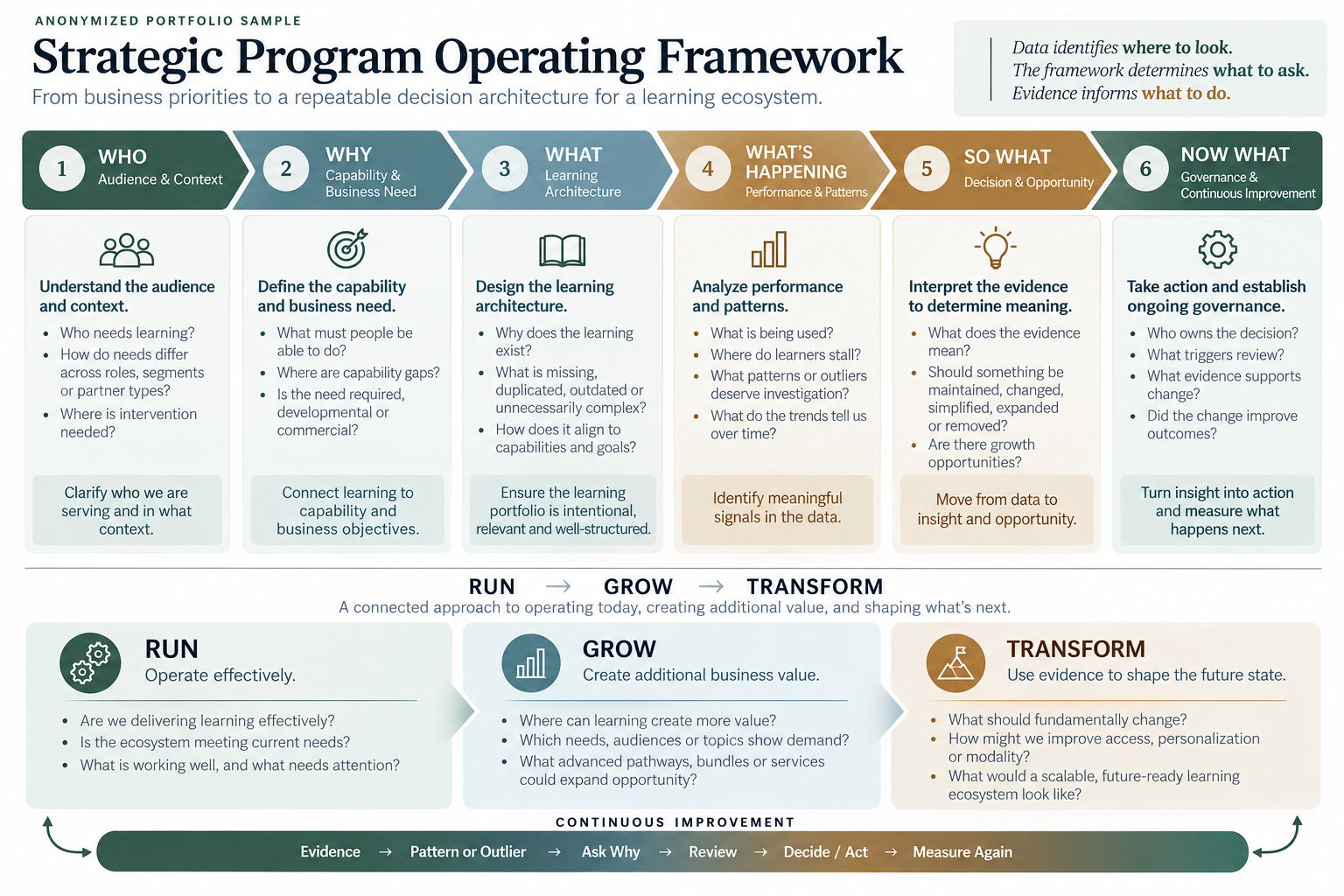
Data identifies where to look.
The framework determines what to ask.
Evidence informs what to do.
Run, Grow, and Transform sit beneath the framework as connected business outcomes rather than isolated initiatives.
A framework becomes useful when it changes how work is organized. I began translating the decision architecture into interconnected tools and processes that create visibility across program activity, deliverables, the learning portfolio, analytics, governance, and continuous improvement.
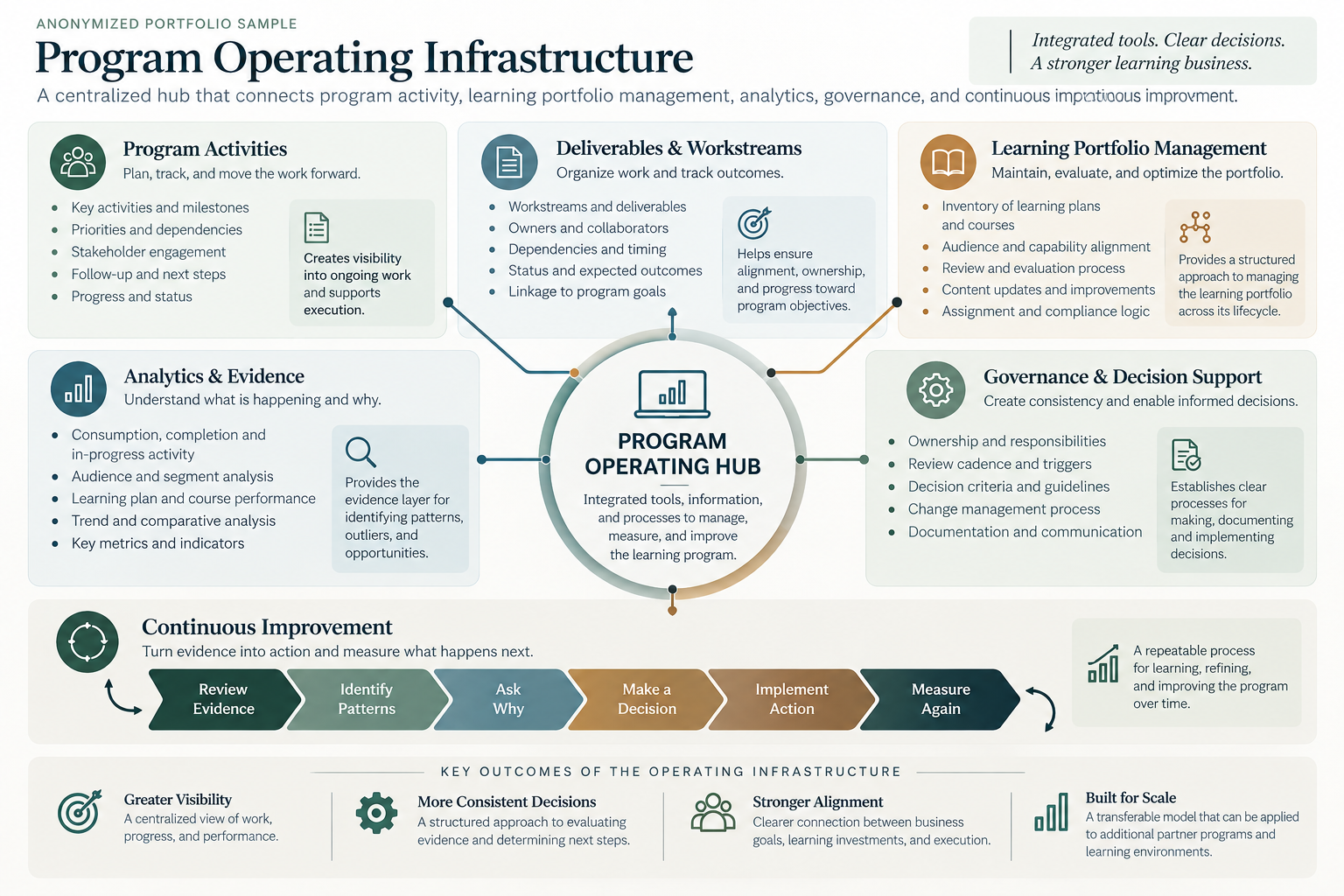
Bring interconnected program information and tools into a shared operating structure.
Create repeatable processes for tracking, evaluating, documenting, and following through.
Link program activity, learning investments, evidence, and business objectives.
Build infrastructure that can be refined and applied beyond a single program environment.
Effective infrastructure creates visibility—but visibility only matters if the data helps answer meaningful business and learning questions. Program analytics provide an evidence layer for identifying patterns, outliers, friction, demand, and potential opportunity.
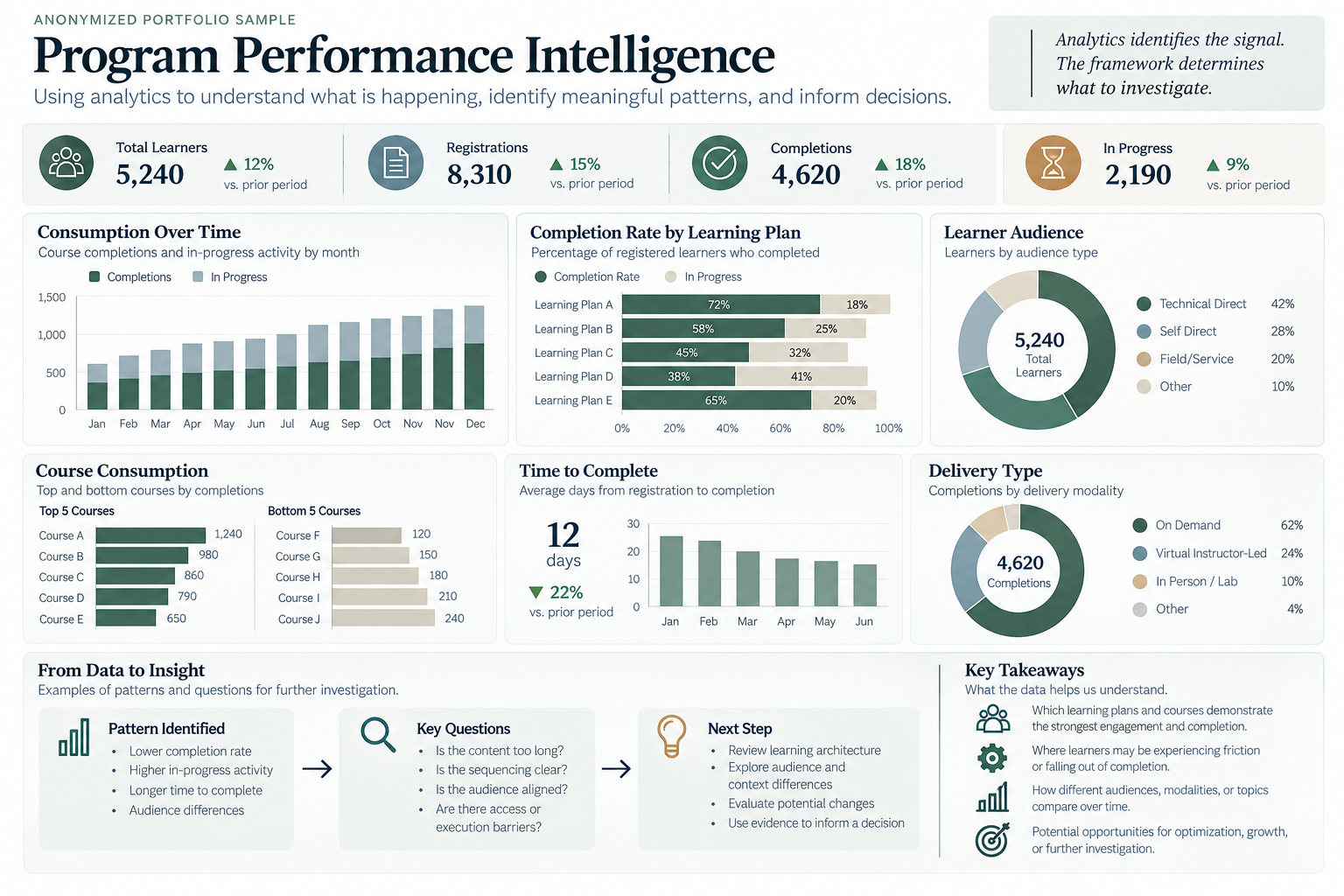
A metric is treated as a signal to investigate—not a conclusion.
Illustrative analytical views use synthetic data. Technical analytics development is a collaborative contribution.
The learning portfolio decision framework introduces a consistent method for evaluating multiple forms of evidence without allowing a single metric—or an arbitrary score—to determine the outcome.
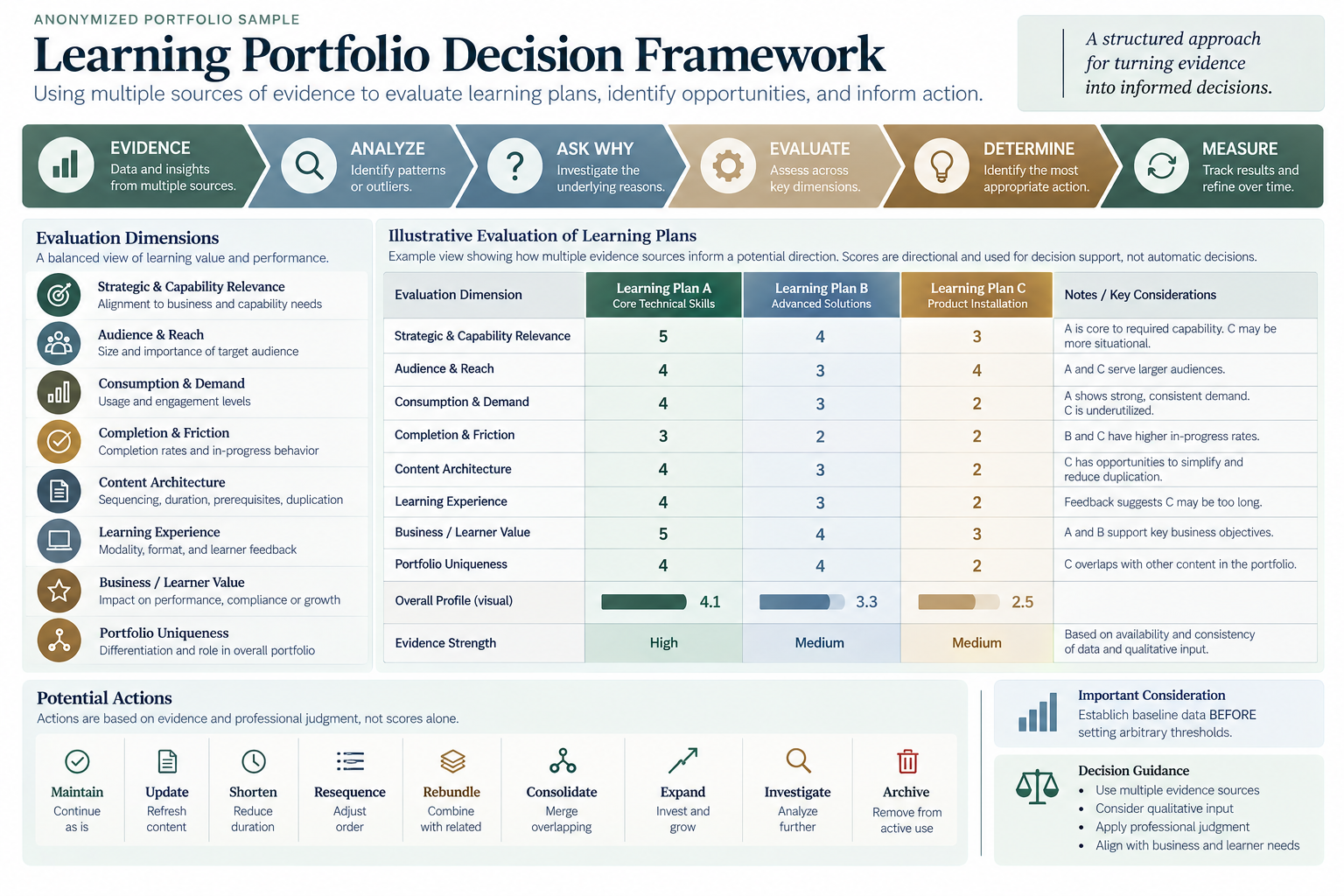
Scores and metrics function as decision signals, not automatic verdicts. Evidence strength, qualitative context, business need, learning architecture, and professional judgment remain part of the decision process.
Potential actions
Maintain · Update · Shorten · Resequence · Rebundle · Consolidate · Expand · Investigate · Archive
The infrastructure is intentionally iterative. Decisions create actions. Actions create new evidence. New evidence can reveal operational improvements, growth opportunities, or the need for broader transformation.
Produces operational intelligence.
Uses intelligence to identify additional value.
Uses accumulated evidence to inform what should change.
Run the evolving ecosystem and measure again.
The same infrastructure used to improve current operations can surface unmet capability needs, demand patterns, advanced-learning opportunities, potential bundles or services, delivery opportunities, and areas where learning may create additional business value.
Where can learning create more value?
Patterns emerging from operations, learner behavior, business needs, and growth opportunities can inform decisions about access, personalization, modality, experience, delivery models, and scalability.
What should fundamentally change?
Transformation becomes an informed response to accumulated evidence—not change for change’s sake.
Although developed within a specific program environment, the operating logic is intentionally designed to be transferable. Separating business questions, framework logic, and evidence requirements makes the model easier to refine, adapt, and scale.
The program serves as a prototype environment for developing and testing an approach that can inform broader learning ecosystems.
Business needs drive learning design.
Data informs decisions; it does not replace professional judgment.
Insights should lead to action, not simply reporting.
Governance should create consistency without eliminating necessary flexibility.